.png)


Attracting Barred Owls to Your Backyard
If you've ever heard a deep, resonant "Who cooks for you? Who cooks for you-all?" echoing through the woods at dusk, you've already met the Barred Owl. One of the most vocal and charismatic owls in eastern North America, the Barred Owl is also one of the most likely to take up residence near your home — if you give it a reason to stay.
Know Your Owl
The Barred Owl (Strix varia) is a large, stocky owl with soft brown and white barred plumage, dark eyes, and a rounded head with no ear tufts. Adults typically measure 17–20 inches with a wingspan approaching four feet. Unlike many owls, they are often active at dawn and dusk — and occasionally in full daylight — making them more observable than their strictly nocturnal relatives.
They are year-round residents throughout the eastern United States, favoring mature mixed forests near water: swamps, stream corridors, and wooded edges. That last habitat type is exactly what a well-designed backyard wildlife habitat can provide.
What Barred Owls Need
Attracting Barred Owls isn't about feeders or birdseed. It's about habitat. They need three things:
Mature trees. Barred Owls roost and nest in large-diameter trees — oaks, maples, beeches, and conifers all work. If your yard or the adjacent woodlot has trees 12 inches or more in diameter, you're already partway there.
A water source. They drink and bathe regularly. A ground-level or shallow basin water feature near tree cover is a strong draw, especially if it's kept clean and unfrozen in winter.
A reliable prey base. Barred Owls are opportunistic hunters: mice, voles, squirrels, frogs, crayfish, and even small birds. A yard managed with native plantings — which support insects and in turn support small mammals and amphibians — creates the food web they depend on.
Putting Up a Nest Box
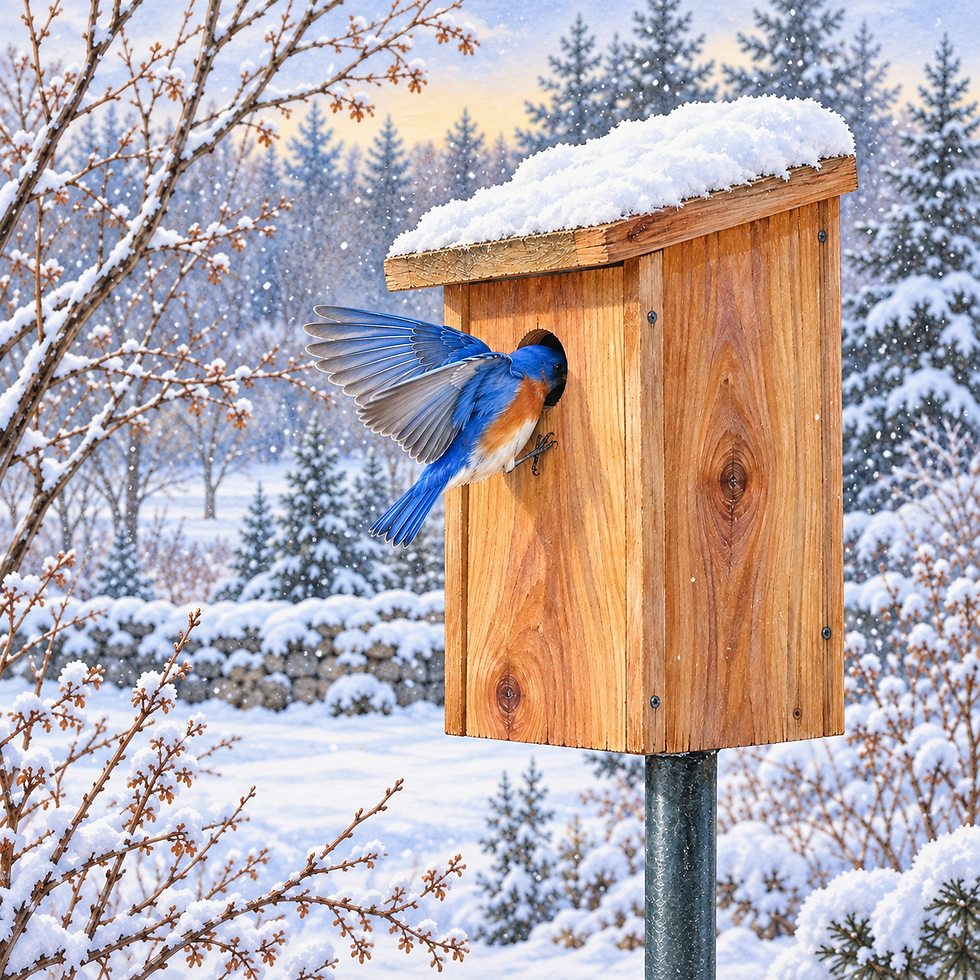
Barred Owls are secondary cavity nesters, meaning they use existing cavities rather than excavating their own. In managed landscapes where large dead snags are often removed, nest boxes fill a critical gap.
Box specifications:
Interior floor: 13" x 13"
Interior depth: 22–28"
Entrance hole: 7" diameter
Mounting height: 15–30 feet, on a large tree facing away from prevailing wind
Place the box at the edge of a wooded area with open flight lines nearby. Barred Owls will investigate boxes in late winter, with egg-laying typically beginning in February or March across much of the East. Avoid disturbing the box once a pair has claimed it.
Leave the old nesting material in place between seasons — Barred Owls do not build their own nests and will reuse what's there.
Habitat Habits That Help
A few backyard management choices make a real difference:
Reduce or eliminate pesticide use. Rodenticides in particular are lethal to owls that eat poisoned prey. A single contaminated mouse can kill a Barred Owl.
Leave leaf litter and brush piles. These support the small mammals owls hunt.
Keep some dead wood. A standing snag or downed log provides roosting sites and hunting perches.
Limit outdoor lighting. Bright artificial light disrupts nocturnal hunting behavior. Motion-activated lights over a wide area can push owls away from otherwise suitable habitat.
Sharing the Night
One of the quiet rewards of a backyard wildlife habitat is what shows up after dark. Barred Owls are tolerant of human presence once comfortable in an area, and patient observers are sometimes rewarded with extended views of a bird hunting from a low perch just at the edge of the light.
They are also surprisingly vocal year-round — not just in breeding season. Learning their calls, the classic duet, the caterwauling courtship exchange, the contact calls between mates, turns an evening in the yard into something close to a conversation.
Set up the habitat, put up the box, and then listen. The Barred Owl will let you know when it arrives.


Comments